




Potentiality for Love
2018
Moving image sculpture in 3 silent parts:
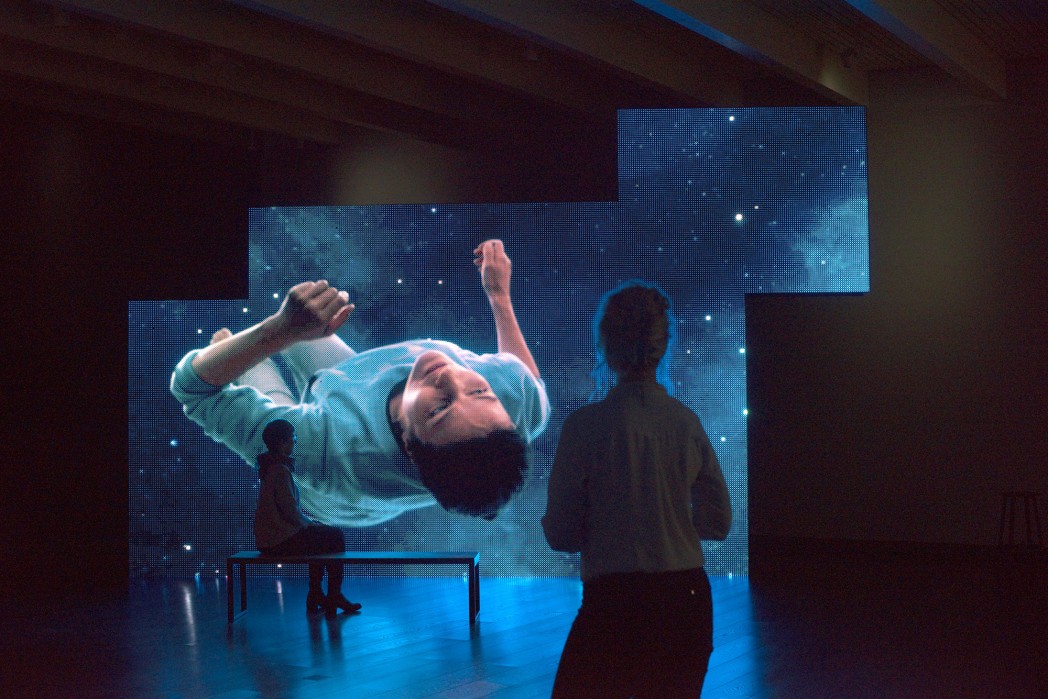
#1 – Angular video sculpture of twenty-two DIP LED modules (4K/HD; 7 min 54 sec loop; sculpture size 614 x 384 x 15 cm)
#2 – Two research tables with attached ‘monitor mirrors’ (4K/HD; 2 min 8 sec and 3 min 6 sec loops; size 100 x 72 x 54 cm)
#3 – Vertical single channel projection (4K/HD; 2 min 35 sec loop; projection size approx 400 x 225 cm)
© Crystal Eye – Kristallisilmä Oy 2018
POTENTIALITY FOR LOVE is an installation about our capacity to feel empathy and love towards other living beings. It draws attention to those human emotions that could form a basis for dismantling the hierarchies between living things and bringing about a shift towards the recognition of non-human species. It explores the origins of these emotions, how we perceive them, and how we conceive their function as part of the broader continuum of planetary life. The installation consists of three parts, presented in the same space in dialogue with one another.
LED SCULPTURE
(MEMORY OF MOTHER)
#1 – Angular video sculpture of twenty-two DIP LED modules
The first part is a hybrid piece that combines sculpture with moving image technology to draw attention to the moment love first emerges.
The LED assembly consists of tiny points of light. From a distance, the points present a clear of the approaching figure of a mother. At a closer distance, the image of the mother opening up her arms dissolves into a constellation of green, red and blue dots of light and the material surface they form.
The LED module sculpture creates an image of distant memory – of mother and the primal unity. It also examines the experience of loss and distance, the moment the mother recedes and, for the first time, the potentiality for love becomes existent.
RESEARCH TABLES
(ONE AND TWO)
#2 – Two research tables with attached ‘monitor mirrors’
The second part asks: Who are we? What is a human being? How close are we to the other? Can love be limited only to those of our kind? The piece approaches these questions through an examination of the historical divide between humans and non-human species by creating a situation which presupposes human presence while simultaneously calling it into question. At the same time, it explores the question of how otherness is constructed in our culture.
The piece consists of two purpose-built tables equipped with thin LED monitors. A chair stands next to each table, and markings on the tabletop indicate where the viewer should place their arms.
The setup resembles a method for treating phantom limb pain, in which a mirror is used to manipulate the memory trace that pain has left in the brain. In the installation, however, the mirror is replaced by the LED monitor, and instead of a human forearm one sees the arm of another primate, a chimpanzee. Instead of a interacting with a human arm, one engages with a member of a different primate species.
ON THE THRESHOLD
(THE CHIMPANZEES SPACE)
#3 – Vertical single channel projection
The third part consists of a vertical projection on a wall. It depicts a doorway opening into dimly lit room. In the doorway sits a chimpanzee on a stool, its back to the viewer. The chimpanzee’s attention is directed towards that other space into which we cannot see. Occasionally, however, it glances back, as if to look at the viewer standing behind it.
The thematic focus of this third part is space and the existence of different realities. This is emphasised by how the actual space itself is painted and lit, which includes a section of the wall that is white, suggesting a vertical blank projection of light, and a spot of light positioned at a point where black and grey sections of the wall meet. Other such reinforcing features are the distances between the elements of the work, the perceived distance between one’s own hand that of the chimpanzee, and the space of that contact within the human viewer.
The work is silent, there are no sounds or words.
More
Making of